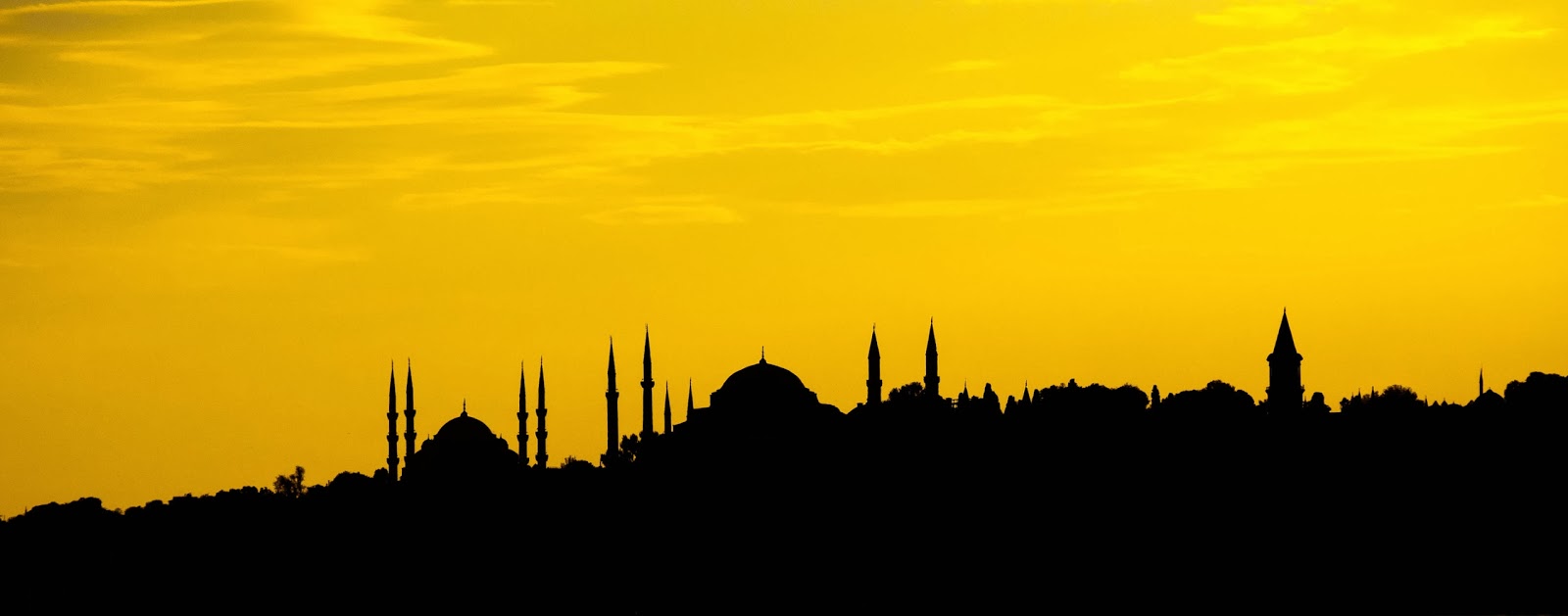
Showing posts with label Fatih. Show all posts

11.06.2013

How Istanbul Found Its Melancholia: A Short Urban History


Unfortunately, our generation did not carry the valuable heritage that it inherited into the future. It may seem slightly extreme, but it was almost a betrayal. -- Recep Tayyip Erdogan, Aesthetic Cities conference, Istanbul, April 2013.

The story of Istanbul begins with the first storytellers. Greek settlers first dropped anchor at Chalcedon, on the Asian side of the Bosphorus, in 685 BC – though it may not have been the most promising locale. According to Greek lore, Byzas, a Megaran and the son of King Lisos, some years later asked the Oracle at Delphi where he should settle down and build his great city. He was given vague plans to look “opposite the land of the blind.”

Byzas sailed up the Aegean to where the Marmara Sea meets the Bosporus, spied Chalcedon and decided its settlers must have been blind to settle in a location so inferior to the one across the strait. There, on an acropolis surrounded by water on three sides – the Bosporus Strait to the east, the Golden Horn to the north and the Marmara Sea to the south – he founded Byzantium, in 657 BC.

Byzas secured his prize by building great stone walls around the promontory. The city flourished, taking advantage of the best natural harbor between the Atlantic and the Pacific and great incomes from trade, fishing and tariffs from boat traffic. All that lucre inspired Dionysian revelry among the people – “Byzantium makes all of her merchants drunkards,” the Athenian playwright Menander wrote – and a fetish for physical expressions of greatness.

In 196 AD, Roman emperor Septimius Severus expanded the city walls, erected a Hippodrome and laid a colonnaded Royal Path. Constantine the Great arrived in 324 and expanded the walls again. He also renamed the city in his name and built a forum, temples and palaces. A few decades later Theodosius built what came to be known as the Theodosian Walls, chunks of which remain standing today and are protected as UNESCO heritage sites.

The city stretched for miles, yet Istanbul had barely been born. Soon after Justinian dedicated the Hagia Sophia in 537, the great church was hailed as the architectural splendor of the world, inspiring jealousy in rival leaders. A thousand years later, when Sultan Mehmet II conquered Constantinople in 1453, he is said to have ridden directly to the Hagia Sophia and converted it into a mosque on the spot.

Mehmet II, known to Turks as Fatih (meaning “conqueror”), undertook the first of Istanbul’s many projects of urban regeneration, sprucing up the streets of the sagging capital and building the Fatih mosque complex, the origins of the Grand Bazaar, and Topkapi Palace, among other works.

The Ottoman era peaked in the mid-16th century during the rule of Suleiman the Magnificent, the longest-reigning sultan. He teamed with the famed Mimar Sinan (architect Sinan) to build Suleimaniye, still the city’s largest mosque and generally regarded as its most beautiful.

Sultan Ahmet I needed a dozen years to build the six-minaret Sultanahmet Mosque, also known as the Blue Mosque, and died a year after its dedication in 1616. Centuries of decline soon followed, during which the city’s center of gravity drifted across the Golden Horn, to Pera.

When Mustafa Kemal established the Republic of Turkey, in late 1923, he shifted the national capital, and the focus, to Ankara. Years later, just as he had embraced secularism and modernity for his country, he looked to the West to revive Istanbul and set it on a course for future greatness. In 1935, the French urban planner Henri Prost won a competition to devise a master plan for the city.

Prost, who had gained renown with his work in Fez, Marrakesh and Casablanca, re-envisioned Taksim as a central square with a broad green space. He demolished the Halil Pasha Barracks, which had been built in 1806 and turned into Taksim Stadium a century later, and remade the square. The Taksim we know today, complete with a monument to Ataturk and 30-acre Gezi Park, was completed in 1943.

By this time, a proud melancholy known as huzun had fallen over the city. “In Istanbul the remains of a glorious past and civilization are everywhere visible,” Nobel Prize-winning Turkish novelist Orhan Pamuk writes in his memoir, Istanbul. “No matter how ill-kept they are, no matter how neglected or hemmed in they are by concrete monstrosities, the great mosques and other monuments of the city…inflict heartache on all who live amongst them.”

7.12.2013

The Madness of Sultan Tayyip


ISTANBUL -- May 29 is an historic date for Turkey, and particularly for this eternal city on the Bosphorus. On that day in 1453, Sultan Mehmed II, known to Turks as Fatih (the Conqueror), took Constantinople from the Byzantines, launching a Turkish reign that continues to this day.

Exactly five hundred sixty years later, a few miles north of where Mehmed II built a castle in preparation to take the city, Prime Minister Recep Tayyip Erdogan turned up at a pomp-filled afternoon event along the Bosphorus to launch a grand and controversial infrastructure project – and his own political decline.

Growing up a dozen miles away in Kasimpasha, a conservative, working class district on the north bank of the Golden Horn, Erdogan earned a reputation as an indomitable brawler. This take-no-prisoners persona propelled his political rise, into office as mayor of Istanbul in 1994, and, nine years later, prime minister.

After a decade of strong economic growth, today's Turkey is brash and influential, much like its leader. Istanbul, the country’s cultural capital and economic engine, has developed into a tourist mecca and go-go metropolis of 15 million, where jackhammers, scaffolding and construction cranes are as familiar as the city’s Virginia Slim minarets.

But now the lord of the realm appears to be fighting an army of ghosts in addition to the usual suspects. That groundbreaking ceremony, for a third bridge across the Bosphorus, presented a trio of offenses that pushed public ire beyond the breaking point. The $3 billion project will require the razing of one of Istanbul's few remaining forests and is going ahead despite the opposition of environmentalists, urban planners and the Istanbul master plan.

During the event, officials announced that the bridge would be named after Yavuz Sultan Selim, a 16th century Ottoman ruler. Selim the Grim, as he's known, is remembered by Alevis -- a moderate Islamic minority of about 15 million people in Turkey, or 20 percent of the population -- as responsible for their mass slaughter. Selim is no hero to progressives either: in 1515 he made printing, a recent invention at the time, punishable by death.

Finally, after finishing up his remarks on the bridge, Erdogan directed a few words to a small band of demonstrators that had refused to give ground that morning to bulldozers attempting to uproot a handful of trees and begin construction on a replica barracks and mall project in Taksim, Istanbul's central square. “Do whatever you want,” said Erdogan, more paternalist than pugilist. “We have made our decision on Gezi park.”

“That really pissed people off,” said Imre Azem, the director of Ekumenopolis, a 2011 documentary about urban transformation of Istanbul. Azem was among the first handful of campers at Gezi Park the night bulldozers first arrived, Monday May 27. “So a lot more people came, and then there was the first dawn operation, at 5am Thursday, and after that it got huge."

We all know what came next: the government's harsh crackdown on Gezi demonstrators sparked mass protests in dozens of cities across the country, resulting in thousands injured and arrested and at least five people killed. The question now is whether all these events might lead to Erdogan’s demise. In a way, they already have.

Rather than cowing their leader, the mass protests have exposed his tin ear and stoked his inner despot. In a midnight session this past week, parliament passed a bill that castrates the country’s leading body of architects and planners (Chamber of Turkish Engineers and Architects), handing to a government ministry the chamber's ability to review major urban projects and issue permits and visas.

This is a direct affront to the Gezi protest movement, which was at root a fight against authoritarianism and government-controlled urban development. The new policy will essentially allow development by fiat, leading to more third bridges, more Gezi Parks, and more public protest. Instead of offering a solution, Erdogan has presented the protest leaders his middle finger.

What’s more, as a result of financial and monetary instability sparked by the protests, Ankara has launched investigations into financial market dealings with foreigners, and more recently into capital markets and its foreign exchange deals. These beg the question, why would a leader whose considerable reputation rests largely on a decade of economic dynamism (in addition to the shackling of the military) endanger the country’s credit rating and potentially scare off foreign investment? Why would Erdogan put Turkey’s great 21st century growth story at risk? His nature.

When cornered, a brawler tends to keep fighting. “Some people are saying I'm too rough," he said in June, referring to his response to the protests. "I'm sorry. This Tayyip Erdogan is not going to change." If he had been a bully before, post-Gezi Erdogan seems a modern-day Selim the Grim, with a dash of the madness of King George.

"Social media is the worst menace to society,” he said during a TV interview, despite the fact that his official Twitter account has more than 3 million followers. He blamed the protests on the international media, foreign extremists and an insidious "interest-rate lobby," among others, and said the same forces were behind the recent protests in Brazil. “The same game is being played in Brazil,” Erdogan told a rally of his supporters in Samsun. “They are controlled from the same center."

Unaware of the irony, Erdoğan urged Alevis, who have led the protests in many cities, not to be provoked by the efforts of the main opposition party. "Right now, the owners of the TV channels and newspapers that provoke the Gezi events, those who want to pour Alevis onto the streets, are all members of the [opposition] CHP,” he said.

The most troubling sign may have come this week, when he named Yigit Bulut, a TV personality who worries that world powers are trying to kill the prime minister via telekinesis, as a top economic adviser.

Leaders of Turkey have rarely wanted for foils or been big on checks and balances, but Erdogan’s decade in power appears to have warped his understanding of his position, and of democracy itself. A couple months ago he was at his peak, angling to rewrite the constitution, install a French-style presidential system and remain in office until the 100th anniversary of the republic in 2023. That scheme is now in tatters, and every move he makes seems dubious, from his protester conspiracy theories to his fumbled Syria policy and his government's confused, confusing response to the ouster of Mohamed Morsi in Egypt.

The government's response to the Gezi Park protests appears to have reduced public support for the the prime minister. A survey released in June found that Erdogan’s job approval ratings had fallen more than 10 percent since April, while support for the AKP had dipped one percent. Looking longer term, the very commercialization and urbanization Erdogan has ridden to economic glory has drawn millions of Turks to the cities, creating a more informed, urbane populace and perhaps starting to erode his largely rural, conservative base.

Still, there’s no reason to expect the AKP to fade from Turkish politics anytime soon. Millions of supporters still respond to the snap of Erdogan's fingers, but his stranglehold on national power has slipped. He's lost the political deftness that propelled his rise and, with elections looming next year, is barred by AKP rules from running again for prime minister.

The auspicious date of the third bridge groundbreaking was surely no accident. Erdogan has repeatedly linked himself to grand Ottoman-era rulers, such as with the opening of the Panorama 1453 Museum a few years ago. His visions -- the third bridge, the Marmaray rail tunnel under the Bosphorus, the world's largest airport, the $2.6 billion financial center, the Camlica Mosque -- might all be viewed as efforts to leave his mark on the former Constantinople.

But now that conquest has been slowed, along with Erdogan's political career. He'll still rank among the best leaders the republic has had, but his dream of becoming a modern-day Fatih or a second Ataturk will remain just that. The debate about whether he's lost his marbles will likely rage for some time, but for Sultan Tayyip, the end is nigh.