8.24.2006

A Pleasant Drive with Abid

Imagine, if you are able, the following: Srinagar, a city of one million inhabitants and about half as many motorized vehicles, does not have a stoplight. Nowhere in this maze of miles of paved and gravelly roads do timed, colored lights regulate the to and froing, the come and going. Oh, wait, that’s not completely true. They do actually have a few of them, on M.A. Road and at Jehangir Chowk, for example, but they stand sheathed and unblinking, commissioned and built but never used, having apparently offended some circulatory sensitivity just prior to their debut. Nor are there curbs, per se, or shoulders, barriers, lane markings, speed limits, or traffic signs of any sort. Nor, finally, do policeman keep an eye out for traffic violators; with an insurgency going on, they have bigger concerns. So it is that the pedestrians, stray animals, motorcycles, bikes, trucks, army convoys, cars, and narrow streets present a seething, chaotic mass of danger and mayhem, right?


Perhaps, yet there is little in my rather hermetic life here in Kashmir that I enjoy as much as the nightly ride home with Abid, my editor Sajjad’s driver, weaving through the untold moving and immobile obstacles, buoyant Bollywood songs bouncing from the stereo in rhyme with the scenery whizzing past. Bus in the way? Just lean on the horn and it will slide subtly to the left to give us room to pass. Sheep at 1 o’clock? Whip right and the coast is clear, for a second.

Abid is leaning on the horn again as we zip around a corner at about 60 kms/hr and there is a dog smack dab in the middle of the street, which is hemmed in by pedestrians on our left. We neither slow down nor budge from our path and at the last moment the dog lurches a foot or so to the left and we miss him by inches. Further along, on a relatively straight part of a boulevard divided by a two-foot wide median, a jawan – Indian security officer – is loading or unloading something from a large white truck on the left hand side of our lane. A black and white cow is standing on the median but leaning his great girth some three feet over the short railing and out into the street. Between the officer and the bovine there is less than a meter, yet we barrel onward, undaunted, joyous music spurring us on as a damsel gleefully hits those high notes, up and away she goes, urging us on, within twenty yards now as Abid leans on the horn again. Without looking at our fast-closing vehicle, the jawan presses his body up against the truck and the cow swings his head, neck, and body back over the median – the two synchronized movements providing the necessary additional three feet and we zoom through unimpeded. Similar seemingly choreographed moments happen every few seconds, and I would often see my life rushing before my eyes if they weren’t so effortlessly beautiful, as if all the people, horses, goats, sheep, dogs, chickens and cows had from birth been inscribed with the movements of this dance, knew exactly when a vehicle of a precisely defined width was approaching, and at what speed, and knew the minimal adjustments to make without breaking from their conversation or duty at hand. Or as if precisely the opposite, that all subcontinenters are astounding physical improvisationalists, capable of shifting up, down, left, right, contortioning and manipulating vehicles and carts and children into impossible positions in a fraction of a second at the slightest alarm and whilst continuing about their task. I imagine the hundred similar instances of near mayhem occurring at the same time at any one moment throughout the city, throughout all of India, even, and sense that this inexplicable, impossible dance of the dodge is another Indian wonder to behold.

Sure, occasionally someone misses a beat, but accidents just might be more impressive. Years ago in Jammu I was on a bus that nudged a parked car’s bumper as it was coming to a stop at a tea shop. As we passengers unloaded a small crowd of men gathered and began to take the matter in hand. I couldn’t understand a word of it, but I got the gist. At first the car owner was upset, his car being visibly damaged, but the subdued tones of the discussion soon calmed him down. Then the men who had witnessed the accident began speaking in turn, pointing at the car, the bumper of the bus, and the other available spaces of the mostly empty lot, as the bus driver and car owner listened, nodding occasionally. Soon enough a settlement, in which the car owner clearly got his due, had been reached, the bus driver and car owner shook hands, and all went into the tiny cafĂ©. Not fifteen minutes after the accident occurred, justice (and chai) had been served, and so resumed the great improvisation.

A few days after I arrived in India I had just gotten into the car with Sajjad, my editor, and told him that I would like to get my own transportation.

“But you don’t need it – Abid can give you rides.”

“Yes, but I like to be able to go where and when I need to, to cover a breaking story, for example, or visit a friend.”

“Yeah, yeah, I see,” he responded, as he often did when trying to think of a good counter-argument. “Well perhaps you should have a bike.”

“A bicycle, well I guess that wouldn’t be terrib…”

“No, no, a motorcycle,” he corrected. “Something like that,” and he pointed out the window to a chap riding a Honda next to us.

“Oh, right, well maybe I could do that. Wonder if I could get a used one.”

“Perhaps, but the bigger issue would be learning how to drive on these roads,” he said, turning to me and smiling.

“Yeah,” I laughed, “there are not many rules.”

“Not many?” he looked at me. “There aren’t any.”

And as we zoomed the wrong way down Residency Road, a main downtown artery analogous to Sixth Avenue in New York, and co-mingled with all variety of pedestrians and honking vehicles around a traffic circle and onto Polo View, I could only agree. Posted by Picasa

8.18.2006

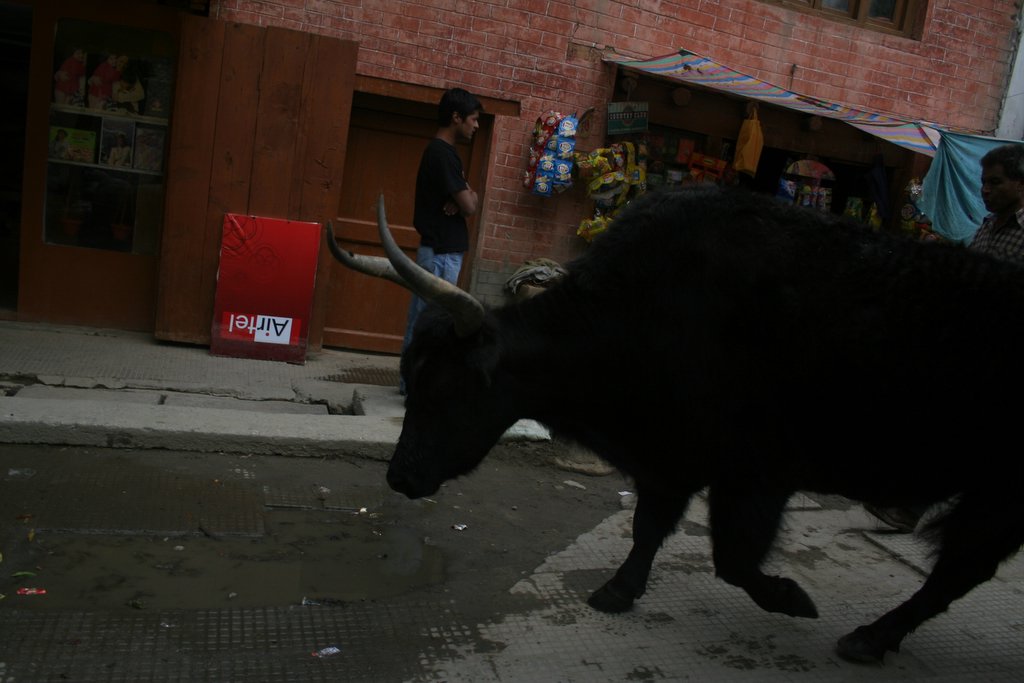
OK, so after a hard day of pedalling I'm relaxing in this alleyway with Billy and an old lady when all of a sudden I feel the earth move beneath my feet. I turn to my right and -- holy crap! -- a two-ton bull on some urgent errand is barreling down this five foot wide path. The thing was ginormous, with shoulders a man wide, coming within about a foot of pedestrians on either side, but nobody blinked. Not this guy across the way, not the old lady, and definitely not Billy.


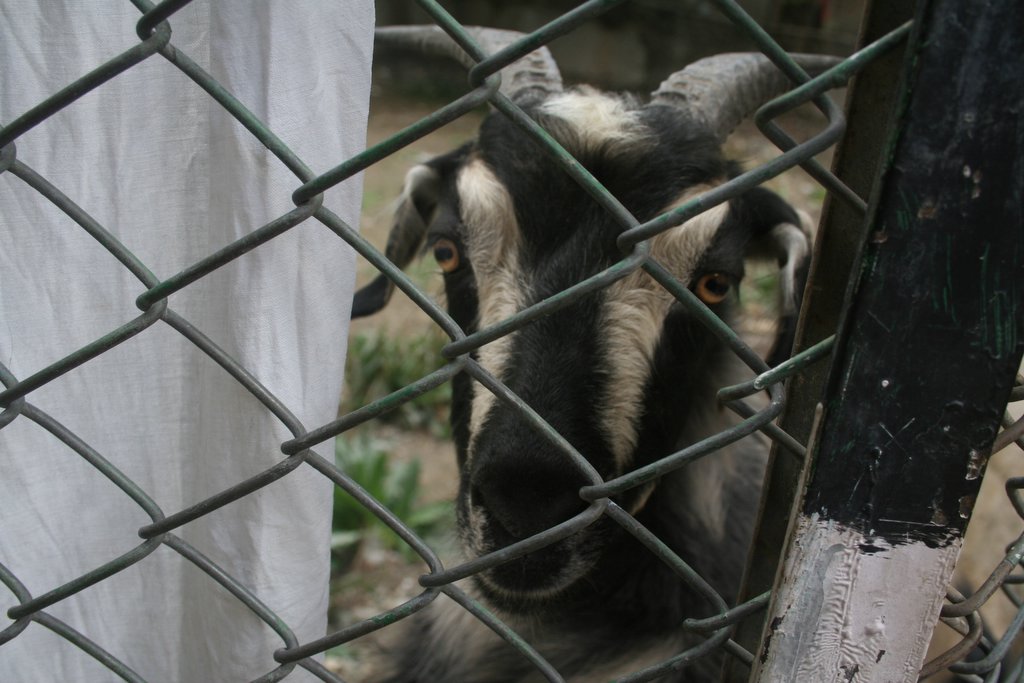
Here's Billy. Ever seen that cartoon -- perhaps it was a tom and jerry that didn't include tom and jerry -- where the skinny, haggard, hick, upright-standing wolf loses all his possessions because of a goat he calls Billy? The goat eats everything and does nothing he asks except follow when he says, drawling, "here, Billy, Billy." so i spy this goat penned in a sunken cage, he's working on some grass about fifty yards yonder and i say "here, billy. here, billy, billy," not expecting much. But lo and behold he saunters over and climbs up a 70 degree vertical rock face until we are face to face. But the claim that mountain goats will eat anything is a myth -- he turned up his nose at a piece of my banana. Posted by Picasa
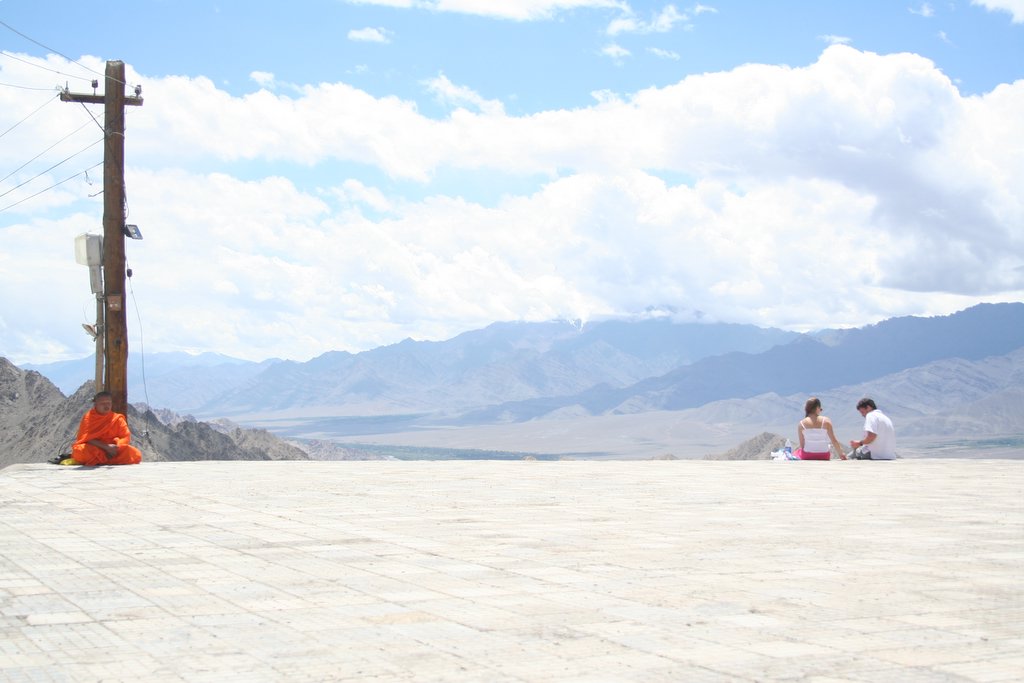
Check it out -- the monk turns inward, while the tourists look out into the world.


 Posted by Picasa

Last Day in Leh -- 8-16

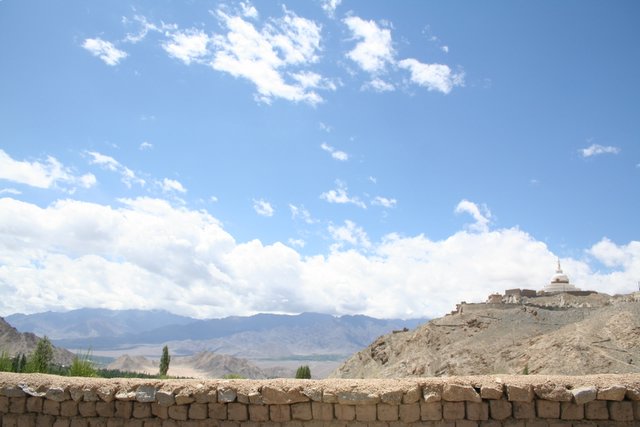
Rented a bike on my last full day in Leh and cruised around surrounding mountains and villages. Here's a shot of a gorgeous stupa (Buddhist temple) at about 12,000 feet -- takes a lot puff to get up that high on two wheels.


Monk has chosen an advisable vantage point at which to do the wash.


This old monk LOVES to sweep the street. Ours is not to reason why. Posted by Picasa

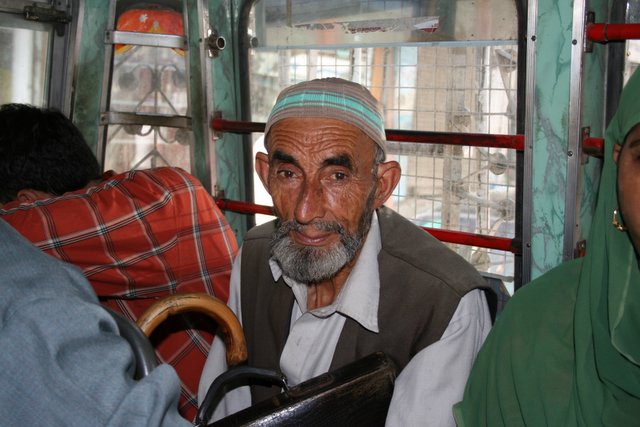
Beautiful Old Kashmiri Man on Bus

Classic Kashmiri dude. Great, hooked nose, long face, skull cap, genial manner. Posted by Picasa

8.06.2006

Dancer in the Dark

Power outages are common throughout India, some due to weak or faulty lines, some scheduled as a means to control overall demand, and still others due to acts of nature or negligence. As a result, most Indians have learned to take such small hurdles in stride. No shrieks of terror or cursing at unseen demons – mostly they continue with what they were doing, provided it does not involve the use of electrical devices, confident the nuisance will be remedied in good time.

I recently had a chance to witness this sang-froid firsthand. I was interviewing Ajaz Rasool, the Superintending Engineer for the efforts to preserve and conserve Dal Lake, in the tiny sitting room of the Kashmir Observer offices. We were sitting on opposite sides of a small wooden table, upon which we had been served tea. Two feet to my left were three windows thrown open to the dark and fresh Srinagar night and to the mountains beyond, where a thunderstorm was brewing.

A bronzed and hefty Kashmiri, Rasool is able to talk at length on various technical minutiae. After about an hour of his verbiage I was finally able to ask him why, if LAWDA has been doing all of this great work he'd been recounting, had the High Court come down so hard in its ruling the previous week?

“I’ll tell you what happened there,” he responded sharply, winding up for another long delivery as rain began tapping at the window. “They were saying that we’d only done part of the job. You see Dal Lake”...and then the power went off without warning. I blinked and looked up at the ceiling and started to apologize, but he went on undeterred...“is a shallow lake, and it has its own species of flora and fauna. There are so many varieties here that…”

I could not see six inches from my face, except when the lightning flashed, and this government official is sitting four feet away from me and talking as if we’re chatting under a sparkling noontime sky. “As a result, we have prolific growth of weeds and various reeds and other beds of various sorts.”

I smiled and almost giggled; how could I take notes? And now the storm has blown closer, the wind is whipping in through the open window and the lightning flashing every few seconds, lighting up his face and his hands, which he is employing as a complementary communicative tool, and his eyeglasses, which reflect my stunned face and the wondrously ridiculous scene back at me. Still he takes no note, and on and on he continues…

“And this growth creates a sea of aquatic fauna, so thick that it blocks the light of the sun and slows photosynthesis.” To a neophyte this seemed a contradiction, but there’s no way I was about to interrupt. “The reed belt in the northern part of the lake can just get out of control, and that’s why we have reed management, which is very difficult, and delicate.”

And by now my eyes had adjusted somewhat and I could see just how much he was using his hands to carry his shovel-fulls of BS across the small wooden table and into my field of vision, my notebook, and hopefully my article. His arms moving up and down, over his head and between his legs to accentuate points, and quite possibly waving planes into their assigned gates at Srinagar airport ten kilometers away.

“Just because the judge cannot see any difference in the underwater growth above the surface,” – the lights flickered on again -- “doesn’t mean we’re not making any headway.”

And Rasool leaned back and smiled broadly, pleased not only with his finely calibrated performance, evincing as it did his mastery over both the inadequacies of man and the power of nature, but also with that final punctuation mark, a viable for defense for millions of souls trying to prove they’re accomplishing something, anything, yet lack sufficient evidence.

My First Wazwan

There is a Kashmiri word that, when spoken aloud, stops local men in their tracks, inspring some to wax nostalgic about great gustatory accomplishments, of exquisite chunks of mutton, and of the great traditions of the valley. Others frown slightly a smile wanly and put a hand to their stomach, recalling days of meat overload and their own digestive limitations. That word is wazwan, and it is the most common type of feast in this region, partaken of whenever there is any notable celebration. This past weekend a friend of Farooq Shah was getting married along the banks of the Jhelum River, and so he invited me to join the feast.

“Have you ever had wazwan?” he asked me en route.

To which I had to reply that I had not.

“Oh, you will love it,” he said, in that singsong slightly British accent of his. “So much meat, and men going at it like lions.”

After a couple wrong turns down windy, dusty, dirt paths enclosed by walls on either side, we found the place. Several men who were milling about at the bottom of a staircase came over and the host said hello to Farooq, Javan – his friend who also came with, and introduced himself to me. Then we were whisked up the stairs and into a large room with no furniture, where fifty or so men were seated in small groups of four or five, chatting amiably. A dozen young boys were wandering about busying themselves, and the three of us slipped off our sandals and found a spot along the far wall. (The women apparently have their own gathering, where food is also served and songs are sung, or so I was told.) I was of course an immediate sensation among the younger set, who huddled close for a better look and became excited when I pulled out my camera and started snapping photos, and even more excited when I pulled out my tooth.

After an hour or so rolls of white cloth were rolled out in two large concentric squares, with the men seating themselves on either side. Then many silver platters piled high with rice were placed on the cloth, spaced about three feet apart.

“David, do you want a plate of your own?”

“Uhhhh, I don’t know,” I responded. “What do you mean?”

“These platters are for four men each…do you want your own, smaller plate?”

“No, no, I don’t think so….Why?”

“Well, because it can get a little,” he tried to think of the right word, or tried to avoid it, maybe. “I just think you might….let’s just get you your own, OK?”
I thought about it and hell if I wasn’t going to go all in.

“No, that’s fine, I’ll be fine.”

Soon after the groupings had been made clear – I was with Faroog and Javan and some twentysomething guy we didn’t know from Adam -- two men began circling the room with large pots, ladling chunks of orange-colored, curried mutton into the center of each rice pile, and immediately the talking stopped. Everyone dove their right hand – the left is considered unclean, as that is the one with which Indians wipe their bum with water after going to the bathroom – into their portion of food, grabbing mutton chunks and ripping meat off the bone to mix with rice and stuff into our mouths. A glass of yogurt was served, and each group was given a dish of onions and chutney for flavor. A minute later another man came by and dropped four smallish meatballs on our platter, and close behind him another server, this one with spinach and cheese in a green sauce, almost immediately followed by another who delivered yet more mutton on the bone. By this time my hand was yellowish gold and covered with chunks of various unidentifiable foodstuffs, my nose was running and I was loading meat and rice into my mouth too quickly to speak, almost too quickly to taste. I looked up to see a feeding frenzy, a room full of men of all shapes and sizes stuffing full hands into their greedy maws – amazingly they rarely if ever dropped a single grain on the ground or got curry on their cheeks, while I had enough grub on the ground in front of me for a small meal and my face looked much like my right hand. The only sounds were of glorious gluttony -- ladles hitting metal, aggressive chewing, and loud sucking as bellies everywhere filled to bursting. Lions, indeed.

“Good, right?” Farooq asked, swallowing.

“Yeah,” I answered, taking a swig of chunky yogurt. “I think so. Why do they serve so fast?”

“That’s wazwan,” he smiled. “But the meat is good, isn’t it?”

“Yes, it is,” and right about then I settled into a groove.

On and on the food came, a sixth round of meat, then a seventh, often before we’d finished the last, or perhaps even the one before, all in about ten minutes. But by this time I’d really gotten into it, swooping down and digging in, shoveling, and swallowing, on the attack until the bitter end. A boy that had taken a fancy to me was staring, waiting for my reaction.

“We’re wild animals,” I told him, eyes wide. He and his brother laughed and smiled back at me. We took a few pictures knee-deep in the feasting and then continued.

And just as I was getting really full, oh lord god, came a giant mutton ball some six inches in diameter. As Javan used his right hand to carve it into four sections, I sat back and caught my breath, eyeing that grayish-blue sphere warily.

“This is the last one,” he said, reading my thoughts. “You’ve done good.”

Later that evening I visited my new friend Agha Ashraf Ali, 84-year-old Oxford and Cambridge grad, PhD in History, former professor at UMass and father of Kashmir’s greatest poet, to whom I posed this question.

“Agha, at wazwan, why do they serve so fast?”

“Because they’re bastards!” he responded immediately. “That’s why.”

This should be taken with a grain of salt, because he adores the word “bastard.”

Gung-slow

Jetlag, the local kite population, and the local Muslim population all made their presence felt quite early this morning, as I woke up to stay around 3:30 am, partially because of my off-kilter body clock, but aided and abetted by the large and noisy raptors that perch just outside my window and scream their lungs out from dawn onwards, hunting Himalayan roosters, they are, and the muezzin’s morning call to prayer, which occurs pre-dawn.

After some breakfast and a paper I head over to the KO offices only to find them shuttered, but as I’m leaving Sajjad arrives with his brother. “You too early for us,” he says, flashing that Mona Lisa smile.

We go back up and into the office, which is smaller than my bedroom in Brooklyn, yet divided into three teeny rooms and a larger computer room where most of the work gets done. Even so, for our purposes, it will keep us close and serve us well.

“So, you read today’s paper?” Sajjad asks me once we are seated, mountain view out the window to my right.

“Yes, I did.” I responded.

“Any thoughts, or comments?”

“Well, yes, there are a few things,” I responded, and went on to tell him that the stories needed more analysis and perspective, as well as the other side of the story – a few of them read almost like press releases for politicians and power players. He understood, but made a valid counterpoint,

“The problem is that most of our stories come into us in the late afternoon or evening, so we have very little time to do additional reporting. It’s difficult enough to get them written up and polished for publication by deadline.”

I suggested an early afternoon delivery time, which is a future possibility.

Sajjad then asked if I had any story ideas.

“Yes, I have a bunch,” and I dug a printout out of my bag.

“Firstly,” I continued, “there is a UN observer group here. What the heck are they doing? Nothing, it seems, but still they stay in Srinagar, and a new commander has just been put in charge, from Croatia, I believe. I’d like to interview him and see what his plans are, and also see what the locals think of the UN.”

“OK,” he nodded.

“Also, I’ve been in contact with a couple of analysts and I’d like to do a piece on the Kashmir conflict in the wake of Mumbai serial bomb blasts. How it might affect the situation, that sort of thing…”

“Right, sounds good,” he nodded again and smiled slightly, legs crossed on the faux leather bench opposite me.

“Oh, yeah, and I’ve been reading about how Indian army soldiers have been committing suicide and as a result they’ve been instituting all of these stress-reduction measures, like yoga and therapy.”

“Yes, yes, that’s a possibility, too,” and he looked me in the eye and I had a feeling about what was coming. “But David, these are all very sensitive issues. We have to be careful about offending people here in Kashmir, because there so many sides to every issue. And you, too, might find some difficulty reporting these issues....because...well for one reason because nobody will speak to you on the record.”

“Well, that shouldn’t stop us from trying.”

“No, it shouldn’t. And it won’t,” he responded, smiling slightly at my steadfastness, I’d guess. WIth his eyes he made clear I should stay away from conflict-related stories for the time being. “But for now let’s keep you working on other things.”

And he asked me what I was interested in and we discussed a few other matters of less consequence, but this conversation essentially set up the battle of wills that would occur daily between Sajjad and I -- he, in looking out for my safety, intending to keep me away from the conflict, and me doing my best to work on the very reason for my coming to Kashmir.

8.03.2006

An Auspicious Arrival in Kashmir

ok, so after zigzagging and stop-going through almost an hour of hellish, 100-degree rush hour delhi traffic i arrive at airport 30 mins before departure to catch flight to srinagar on wednesday morn. bags were checked, double-checked and re-checked, as was my person, passport, ticket, and sanity, all in about a 30 square foot area -- imagine queuing up to the bar and getting gin poured in your glass, turning ninety degrees still in line to a little stand where two nice ladies drop in three ice cubes, strolling five feet in unison with endless others to get a shot of tonic, going through a curtain three feet ahead to win a slice of lime, before finally turning another 90 degrees to get a straw and you begin to imagine the bizarrely claustrophobic efficiencies of the indian airport system (as well as how much i could use agin and tonic right now).

after that i go out onto the tarmac, well it was actually a sort of giant tent set up on the tarmac, and point my luggage out to the Jet Airways workers so they could load them onto the plane. sweet,right? not our fault if you don't get your crap at the other end, no sir. finally, one last body and bag check as we board shuttle bus to take us to our plane roasting in the sun off in sector 73, board and we're off. two things come to mind while, flying over some himalayan foothills, lunch is served. firstly, why, after all this impressive, EL AL-style security, are they giving us actual metal silverware, including the butter knife? and secondly, dang, this curry is about the best flight eats i've ever had.

so then we land and the real fun starts. i fill out some foreigner registration forms, grab my bags and blissfully head outinto afternoon sun (i've made it, i've finally stinking arrived! look atthis place, friggin' srinagar is gorgeous. i'm a genius. this is going to be great. what the hell were all my friends and fam worried about? idiots.) to meet my co-workers, who'd promised to pick me up. you know that part whereyou exit the terminal pushing the cart after a long trip away and the doubledoors (ding!) whooosh open and there's all those family members andbeautiful girlfriend or boyfriend with anticipatory smiles leaning on therailing and staring hard into every face in the hopes of transforming itinto their one and only? and there's a few guys in white dress shirts anddark ties nonchalantly holding white placards that read "dennis needlebaum"or "sanjay gupta" on it, chatting with each other and generally not giving acrud? well so i walk into one of those, except it's outisde, on a dirt road, and with machine-gun toting military and police guard on either side, looking like they'd really like to have something to do, something involving a whitey perhaps -- and i've got nothing. no placard with my name on it. no friendly looking local stepping out of the crowd with a smile and proffered right hand. certainly not a comely lass. and so i push on through, assuming they're probably stationed a little further on, near their car, didn't want to leave it...or something. and nothing, still nothing materializes except for two tout taxi drivers who rapid-fire and competitively promise and guarantee to deliver me without delay to the world's most fantastic and astoundingly cheap houseboat, i cannot imagine the glories. but right now i'm trying to imagine what could've kept sajjad and farooq from showing up at the airport at the appointed hour at the appointed time at the stinking right airp...wait, there aren't two dang airports in teeny srinagar are there? a quick check with my new friend abdul the security guy reveals that no, there are not. so they should be here. i wait and chat with those two taxi drivers, who've now become friendly and heard about my plight and along with every other security chap asked if i had the phone numbers of my local contacts, to which i had to respond in the negative because sometimes, as most of my friends know, i am deeply idiotic. and so there i am, flies andbeggars buzzing about all of my earthly possessions sitting on a listing metal cart in front of me, surrounded by strange, bearded men, most of whom are brandishing high-powered weapons and looking askance, a bloody militantinsurgency all around and i don't know a single soul. and there i wait, thinking your average everyday thoughts (what could be keeping them? hmmm, i wonder where they are? why didn't i right down their phone number?....how do i know these guys even exist? i never talked to them on the phone -- all email! shoot oh shoot oh holy heck shooting dang it shoot i've fallen fortheir trap and these guys are terrorists and now here i am like a lamb to the slaughter, like a stupid american what the hell have i done.)

"why don't you just take a taxi to this address?" abdul asks, looking at me and holding the email paper i'd shown him with the only contact info in mypossession -- the address of the Kashmir Observer, the (non-existent?) newspaper for which i'd flown 7000 miles to work. and you know what, it sounded like a great idea.

so that's what we did and after a couple small twists and turns we found the place, nice blue banner on the outside of the building, and there was sajjad, scratching his head and saying hello and feeling bad and also a bit surprised. "i thought you were coming tomorrow," he said.

and of course that's what my last email had said.

Later, on the stairs of my hotel, I met Farooq Shah, who looked precisely as I’d envisioned: short, thin, bespectacled, and slightly hunched, with a leather-bound folder brief under his arm and a tendency to get excited and say British sounding words in the most delicate, sing-song manner. “Lovely,” for instance, had three syllables. We walked the block over to the Kashmir Observer offices, which were about the size of a shoe box and contained six or seven workers, whom I met.

Sipping lemon tea in a pleasantly verdant and secluded garden of the Tao café, Farooq said,

“We will put no limitations on you and your responsibilities at the Kashmir Observer. You can do whatever you want. View this paper as your baby.”

To which I was a bit dumbstruck.

As we paid, Farooq gave me some advice about my smoking.

“You should stop that if you want to live. Don’t you want to live a long life?” he asked me, dead serious and yet grinning. “You should stop smoking because we need good people like you a lot more than we need most other people.”

Which come to think of it was about the sweetest thing I'd heard in a while, and this from a man I'd known about an hour.

6.16.2006

Manmohan and the Burden of Leadership

After two days of roundtable discussions in Srinagar late last month, Indian Prime Minister Manmohan Singh sought to offer the locals his sympathy and understanding.

“I do realize that the people of the state are put to a certain degree of inconvenience because of the prevailing security situation,” said Singh, perhaps referring to attacks that killed hundreds of Jammu and Kashmir residents in the weeks leading up to his visit. “It is our collective responsibility to create an atmosphere where the people of the state can be free from the fear of oppression and terrorist activities and can go about their normal lives like their fellow countrymen.”

In the two-plus years of the current peace process we have witnessed exaggerations, misstatements, aspersions, and near falsehoods tossed off by all sides. Pakistani President Pervez Musharraf speaks of flexibility and seeks improved Indo-Pak relations while maintaining Inter-Services Intelligence (ISI) support for militants and incursions and the various Jammu and Kashmir political leaders offer up conflicting proposals for autonomy and sovereignty and seem to stand on shifting ground.

But perhaps none had been as misplaced and oafish an understatement as this. If the frequent and predominantly deadly attacks of the past few months are any indication, the prevailing security situation is merely a lack thereof, and, in making a stable atmosphere “our collective responsibility,” Singh, although he did mention the possibility of a greater police presence, partially sloughed the primary governmental burden of domestic security.

The statement was representative of the prime minister’s entire Kashmir policy and as he continued his May 25th speech and hit the usual Kashmir talking points – reviving the economy, assisting those who have suffered, improving governance, managing and reversing displacement, and improving Indo-Pak relations – a question arose: Does he consider Jammu and Kashmir part of India? New Delhi has long sought to maintain the status quo, but in recent years seems to view this most northerly state as something of a nuisance – an awesomely beautiful yet hopeless and inscrutable land where chaos reigns and the outlook is permanently bleak, a world apart from their new India, the India of the exploding economy and the limitless future, the India destined to be a world power. Perhaps Singh and other politicians and leaders regard the Himalayas as a shield of sorts, high, deep, and broad enough to keep the trouble out. Perhaps they’re hoping the locals, under the onslaught of unpredictable and increasingly deadly attacks, will return to India’s embrace, as Karan Singh, the last Kashmiri maharaja, did almost 60 years ago. Why else would they not respond more robustly to the brazen attacks of the past few weeks? The suicide bomber that crashed into a military convoy, injuring 20; the grenade attacks across Srinagar and on two tourist buses that killed dozens and injured over one hundred, threatening the all-important tourism industry; and on and on. Why don’t Indian forces aggressively patrol the more attack-riddled areas like Doda and Srinagar? Why don’t intelligence services analyze militants’ strategies and devise tactical plans to defend against incidents such as the recent policeman-disguised attack on Congress in Srinagar? To the April massacre of nearly 40 Hindus in Doda and Udhampur Singh responded, “people of Kashmir have rejected and rebuffed terrorists repeatedly.” The statement itself is dubious and the underlying assumption – that Kashmiris can and should take care of themselves – is risible policy.

In no other part of the developed or developing world would a leader respond so lightly to such terrorist aggression. The Kashmir situation is unique, to be sure, and requires a delicate hand, but a citizenry needs to know it will be protected. For if they are not there is no predicting how they might cast their lot, and with Kashmiris – a particularly diverse and potentially fickle bunch – almost anything is possible. A feeling of betrayal would be understandable.

With the burden of progress squarely on the shoulders of the three key players, why would Singh not work to develop Kashmir and to further the peace process? Although the US-Indo relationship has achieved a new coziness following President George W. Bush’s March visit, New Delhi should not look to its new business and nuclear energy partner for help solving Kashmir. In a not so subtle intimation, Bush offered his support for a tripartite solution on Kashmir while in Delhi – suggesting that after decades of fruitlessness, America might be hoping to wash its hands of the sticky problem. After Pakistan called Indian leaders out for their recalcitrance on Kashmir earlier this year, Singh again pointed to Pakistan’s support for terror infiltrations while calling for a wide-ranging peace treaty and offering an openness to “pragmatic, practical solutions” on Kashmir. Neither side has made any significant strides since.

In his defense, Singh did take two positive strides at the close of the late May roundtable. He offered, for the first time, the possibility of some autonomy for the state, and created five working groups as a means to facilitate communication between Kashmiri political groups, India, and Pakistan, to revive the local economy, and to improve local governance. Additionally, Singh’s early May meeting with All Parties Hurriyat Conference leaders yielded positive strides towards continuing talks. But these measures address only one of this Gordian knot’s three tangles, the concerns of Kashmiris themselves. In regards to relations with Pakistan and Kashmiri security the prime minister has fallen short, and what follows are my recommendations to solve the famously intractable and divisive conflict and thus greatly increase South Asian stability.

Security in Jammu and Kashmir

Prime Minister Singh must first condemn all recent attacks on civilians, tourists, and government and military personnel in the strongest terms and beef up security in the most frequently attacked areas, such as Doda and Srinagar. Some of the 70,000 Indian troops massed near Line of Control regions should be shifted to where they can be put to better use, and the police presence increased. Additionally, New Delhi must reach out to Jammu and Kashmir leaders in assist their help in understanding, avoiding, and responding to terrorist attacks and their perpetrators – hopefully determining involvement of Pakistani-supported militias. Perhaps most importantly, Singh needs to commit to developing Kashmir; improving the local economy will create jobs and prosperity and greatly decrease the likelihood of Kashmiris turning to separatism. If you love your homeland you do not destroy it, unless it has become a wasteland.

Pakistan

Confidence-building measures like opening bus and train lines, mid-level meetings, and screening Bollywood films in Lahore are all well and good, but any real progress between India and Pakistan is unlikely without top-level face-to-face meetings between Pakistan President Pervez Musharraf and Singh. The problem, of course, is motivation: while Musharraf has the possible gain of greater Kashmiri autonomy and even territory, Singh dithers because, the theory goes, he has only land and people and resources to lose. Yet if they are India’s, as New Delhi would argue, then he has everything to gain. If he could secure the terminally unstable Vale of Kashmir, turn around the local economy and bring peace and stability to the region for the first time in over half a century Singh would be widely and rightly revered. Additionally, he would be saving thousands of lives. Is this not reward enough? If not the Indian president is in the wrong business.

Ready to negotiate, Musharraf has said that violence will not solve the problem of Kashmir and that Pakistan is willing to accept any proposal that is acceptable to Kashmiris. This is the perfect opportunity for Singh to commit wholeheartedly to securing and developing Jammu and Kashmir while initiating a series of talks with the Pakistani president and Kashmiri leaders.

Peace and stability will not come overnight, but neither are they entirely out of sight. They require the very quality on which India was founded, which also happens to be the very thing Singh seems to have in short supply: strong leadership skills.

5.23.2006

Now He's Gone Too Far

Ever since the immaculate reception given to Blink, his second consecutive #1 bestseller, the sharp reporter's mind and powerful analytical skills of the New Yorker's resident genius, Malcolm Gladwell, have been given free reign to roam the socio-cultural landscape, alighting wherever their master sees fit to make the broad and dazzling intellectual linkages that have become his trademark. This year alone he has detailed how our fear of pit bulls is a form of prejudicial stereotype and that homelessness, like the long-troubled LAPD, is really about a few chronically bad apples. Then earlier this month came an account of dog whisperer Cesar Millan, which limply informed readers that sincere, fully lived-in physical gestures and phrasings of movement made people seem more authentic. (Ever hear of Bill Clinton, or Bill O'Reilly, or his faux-doppleganger, Stephen Colbert?) I like Gladwell, but with his most recent piece ("Game Theory," May 29 issue), a quasi-review of a book about a new algorithm for dissecting victory value in the National Basketball Association, he has gone too far.

The trouble begins with the opening tip, a subtitle that advises us not to believe our eyes in assessing athletic prowess. Unfortunately neither the book nor the article is about judging athletic prowess -- which is defined by strength, speed, size, quickness, and jumping ability -- but measuring a player's relative worth in terms of contribution to his team's wins. The authors of "The Wages of Wins" are Berri, Schmidt, and Brook, three Stanford economists, which Gladwell apparently views as a selling point, accepting at face value both the efficacy of their algorithm, and, more importantly, their results. After the authors weigh the relative value of rebounds, shot attempts, fouls, turnovers, etc., and plug the data into their secret tell-all algorithm, we are informed that in 2004-05, his best season, Allen Iverson was the league's 36th best player, one season after coming in a slightly less impressive 227th. We are also treated to the revelation that "journeyman forward Jerome Williams was actually among the strongest players of his generation." Iverson may be a first-class ballhog but he is undeniably one of the league's top twenty players, and while Williams might well have gone underappreciated for his tireless work ethic, defensive hustle, and hardhat, lunchpail effort on the boards, he is merely a role player.

These two assessments are thus what NBA experts would call hooey, and if they do not move the reader to put the book down and burn all extant copies they should at least force one to look more closely at the authors and their methods. Mysteriously, Gladwell does not dissect the algorithm or even explicitly describe its makeup. Nor does he apply their mysterious formula to actual league success -- do those players that advance deep into the playoffs or regularly win or have won championships come out on top in the survey, for instance? How do the star players currently tussling in an incredibly tense and exciting NBA playoffs perform in the book? More pointedly, does the algorithm measure strength of will, leadership ability, and desire for the ball with the game on the line? He instead goes in the opposite direction, as is his wont, suggesting that the difficulty of considering all of basketball's inconsistent variables when assessing talent is not dissimilar to gauging heart attack risk or buying a house. Really? And here I've been using the real estate section.

[Bona fides disclosure: I am no expert, but at 32, having watched literally thousands of NCAA and NBA games and grown up as a rabid Bulls fan in Chicago during the Jordan era, I believe I have a special understanding for what makes a player great. I also played basketball competitively in grade school and high school, all while regularly banging bodies and butting heads with four brothers on a blacktop court in the backyard, rain, shine, or snow. ]

The following example better illustrates my beef. Because he was named the league's top sixth-man yet rebounded poorly, turned the ball over frequently and shot a low percentage, Gladwell calls the story of the Chicago Bulls' Ben Gordon "most egregious." Yet what Gladwell could not know, being unfamiliar with Gordon's game and NBA play in general (writing that Iverson "writhes" through bigger defenders is a dead giveaway -- Tim Duncan or Dirk Nowitzki might writhe through a thicket of defenders, while Iverson would glide, slash, or knife), most likely, is that 1. Gordon was a rookie that year, and thus is more than likely to decrease his turnovers as he matures as a player; 2. He is almost never near the basket and therefore not expected to get rebounds; and 3. Gordon is a streak shooter, one of the league's streakiest, and even though that does make him inconsistent, he led all of the NBA in double-digit scoring in 4th quarters in 2004-2005 and was widely regarded as one of the game's most clutch players. Finally, Gladwell's last point that Gordon's poor play led to a Win Score of dead last out of the league's top 33 scorers is not surprising considering that his 15.1 points made him the league's 32nd best scorer. Also, referring again to the case of Allen Iverson, how are we to assess a veteran player that is able to increase his relative worth six-fold over the course of one year? Should this not lead us to question the means of assessment?

Gladwell is not entirely to blame. In a rare misstep, the New Yorker editorial staff wandered out of its jurisdiction with this one. This article could have been a straight book review, with the author addressing the book's material and execution critically. Instead it was Gladwell, perhaps because of some special dispensation, taking and running with deeply suspect information about basketball ability and popular opinion, illuminating few and leaving many in the dark. When it comes to sports, stick with what got you here, Mr. Remnick. Let Roger Angell drop the 411 on baseball, all day, everday. Give us occasional slices of football and other various sports through character studies and smalltown profiles. But until you hire someone who's watched the thousands of basketball games the knowledgable fan or so-called expert requires -- someone who knows what she's talking about -- please refrain from dissecting play in the NBA. To paraphrase the quote Gladwell employs to end his piece: You can systematically track what the players do and then uncover the statistical relationship between these actions and wins, but you will never know why teams win and why they lose until you watch an NBA game.

5.19.2006

The More the U.N. Changes

After three seemingly endless days of talk stoppages, diplomatic sniping, backroom negotiations and still-born proposals sprinkled lightly with real management reform debate, a key United Nations subcommittee agreed to take another short break on the evening of the last Thursday in April.

“I know those 15 minutes,” said U.S. Ambassador John Bolton, referring to the length of the agreed stoppage in the efforts to broker a compromise between the South Africa-led bloc of 132 nations known as the G-77 and China and the more powerful donor nations led by the United States. “We have a bit longer than that, I think.”

Indeed, the break lasted nearly a full hour before the ambassadors took their seats again, agreeing only to delay proceedings until the following morning and prompting a classic Bolton sound bite. “We are at the present moment in the U.N. equivalent of the movie Groundhog Day,” said the U.S. envoy.

In that 1993 film the weatherman played by Bill Murray kept waking up in the same small town on that most meaningless of annual American rites, Groundhog Day. That the disputed G-77 measure putting a halt to U.N. Secretary-General Kofi Annan’s reform proposals was approved the following morning only put the rich-poor standoff in greater relief against the Byzantine task of achieving legitimate progress at Turtle Bay: however much the United Nations attempts or seems to change, member states and U.N. officials inevitably find themselves experiencing extended bouts of deja vu, raising the same complaints, battling over the same turf, and foisting musty proposals.

“Things that happen here don't reflect the reality in the rest of the world,” Bolton told The (London) Telegraph in early May. “There are practices, attitudes and approaches here that were abandoned 30 years ago in much of the rest of the world. It's like a time warp.”

As various reform efforts have wended their way through the system in the last year and come to a head over the past fortnight, a sea of opinions, decisions, and reports has washed over this most bureaucratic of international bodies, none more meaningful than the vote in the little-known but powerful Fifth Committee, which controls much of the U.N. budget. Not only did that vote leave widely praised and necessary reform proposals in tatters – placing involved parties right back where they started – it will also likely force powerful donor nations to decide next month whether to follow through on a threat to withhold funding, potentially compromising dozens of vital U.N. missions around the world.

After widely denounced failures in the 1990’s – Rwanda and Yugoslavia, to name two – and more recent debacles – the unsanctioned U.S.-led invasion of Iraq, the $60-billion oil-for-food scandal, and the lead-footed response to the ongoing genocide in Sudan’s western Darfur region – the 191-member organization has been widely attacked. With peacekeeping efforts quadrupled in the last decade and aid and peace-building missions rapidly increasing since the Cold War ended, the problems are unlikely to cease.

“Reform is incredibly important right now,” said Brian D. Schaefer, Jay Kingham Fellow in the Margaret Thatcher Center for Freedom at the Heritage Foundation, a conservative think tank. “The UN is assuming more and broader tasks than ever in its history, yet the scandals that have come out bring up urgent questions about effectiveness, fraud, and abuse.”

When such questions first became a recurring theme over a decade ago, then-Secretary-General Boutros Boutros-Ghali told The Washington Post “perhaps half of the UN work force does nothing useful.” As he closes in on his early 2007 departure, current U.N. leader Annan has in the past year pushed strongly for major changes in management, the mandate process, and procurement, with minimal impact.

Last year’s protracted discussions on adding members and eliminating the veto in the Security Council went nowhere. A new Human Rights Council was created in February to replace the 53-member Human Rights Commission, which critics attacked for being unwieldy and offering membership to violator nations. But China, Cuba, Saudi Arabia, Russia, and Pakistan were elected to the 47-member council Tuesday, while the U.S., boycotting the group in protest, was not. And late last month the U.S. Government Accountability Office released two reports illuminating widespread internal shortcomings and claiming the body was “vulnerable to fraud, waste, abuse, and mismanagement.” One report found procurement training and expertise seriously lacking, while the other denounced an oversight committee that was funded by the U.N. itself.

The current rich-poor dust-up was incited by Annan’s “Investing in the United Nations,” a 30-page March report that proposes to place greater budgetary control and authority over global staffing decisions – both now decided by the General Assembly – in the hands of small representative groups and the Secretary-General. The proposals would likely make the United Nations more efficient, nimble, and modern, experts say, but also decrease the input of less powerful member states. Thus the resolution drawn up by the G-77 and China, which sought to eliminate changes in budgetary decision-making and called for Annan to prepare yet another series of reports by September, including an exhaustive review of U.N. reform efforts to date.

“The G-77 feel as if they are being coerced,” said Ayca Ariyoruk, senior associate for the United Nations Association’s Global Policy Programs, who has been working with the 132-member group to clarify its position. “The status quo favors their power status: if the management reforms take this power away from them they have nothing.”

Yet in presenting and approving this measure, the poorer member states have unwittingly become opponents of U.N. progress, or as political commentator and Turks and Caicos native Anthony L. Hall put it in a Friday editorial: “this move to maintain the status quo is tantamount to cutting off our noses to spite our faces.”

South Africa's U.N. Ambassador Dumisani Kumalo, whose country chairs the G-77, explained their stance.

“We believe in the Group of 77 and China in the right of every member state to have an equal say in the decision-making of this organization,” he said. “This right for us is not dependent on the financial contributions of member states to the budget of this organization.”

That budget now looms larger than ever. By about the same margin as in the Fifth Committee, the General Assembly plenary approved the South-Africa led G-77 resolution May 8, setting up a potentially larger conflict when the United Nations must establish its budget in June. Under U.S. pressure, member nations agreed in December to tie the $950 million budget for the second half of this year to achieving management reform. The U.S., European Union, and Japan are responsible for eighty-two percent of the annual budget and are thus able to essentially enact a U.N. shutdown, although Bolton has said they would not keep the body from functioning. Legislation passed by Congress in June linked U.S. funding for the United Nations to management reform but included a waiver to be approved by Secretary of State Condoleezza Rice should the cuts undermine U.S. interests.

“The U.S. and its allies have greatly damaged the U.N. by their blackmail,” said James Paul, director of the Global Policy Forum, a U.N. watchdog, who saw a recurring pattern but predicted an unusual outcome.

“Always in the past, other nations gave way to the U.S. threats but this time the others are standing their ground and the U.S. will be forced to give way,” he said. “I expect an agreement that will give the U.N. its second half budget and give the G-77 most of its core demands.”

Schaefer painted a different picture, arguing that more powerful nations “would be unlikely to blithely approve additional funding for a status quo that is not satisfactory.” He also underscored the urgency of the situation. “If we can’t strike now, we might never have such a great opportunity again,” he said.

Don’t be too sure.

3.29.2006

The Politics of Darfur

Speaking Tuesday at an Arab League summit in Khartoum, U.N. Secretary-General Kofi Annan echoed a common and disheartening refrain concerning Sudan’s war-torn Darfur region.

“People continue to be killed, raped and driven from their homes by the thousands,” Annan said. “The security situation has worsened as a result of fighting between Chadian troops and Chadian armed opposition elements on the common border.”

In an update to the Security Council last week, the U.N.’s top envoy in Sudan, Jan Pronk, offered scant evidence that recent agreements and cooperative steps had made any impact.

“The ceasefire does not function; the Joint Committee does not meet; the sanctions…exist only in theory,” he said at U.N. headquarters in New York, adding that countless human rights abuses threatened the peace in Sudan as a whole.

From Pronk and Annan to U.S. President George Bush and U.N. Human Rights Chief Jan Egeland, and from International Crisis Group to Africa Confidential and Human Rights Watch, a growing chorus of discouraging updates and urgent warnings has ratcheted up the urgency on Darfur over the last fortnight. Yet as the world’s worst humanitarian crisis deepens, a lack of international cooperation has underscored the logistical and political hurdles to swift and effective intervention.

Some 200,000 people have been killed and 2 to 3 million displaced since the conflict began three years ago, and in February the turmoil spilled over the border into neighboring Chad, igniting another proxy war and endangering additional hundreds of thousands.

This month Egeland predicted a rise in mortality and dubbed the region “the killing fields of the world,” Human Rights Watch urged the application of sanctions and an arms embargo on Sudan in an open letter to Annan, and an International Crisis Group study warned of an imminent disaster, placing the blame on the Sudanese government and calling for the immediate deployment of a 5,000-strong intermediate stabilization force.

Darfur has become even more explosive because of tensions between Chad and Sudan,” said Africa Program Director for the International Crisis Group Suliman Baldo, referring to government-sponsored raids, cross-border incursions, and criss-crossing refugees. “I don’t foresee any improvement in coming months because I don’t see any change in the attitude of key players; why would the situation improve?”

The vocal tide has swelled on the heels of a March 10 African Union decision to accept U.N. intervention after its September 30 departure.

“I was pleased with the AU decision,” said Pronk, highlighting a lack of international preparedness. “Even though I had expected nine months [to prepare] because I don’t think we can do it, the transition, technically, in six months. We need troops and where are they to come from?”

Two days later the Security Council, expressing a similar query, formally asked U.N. Secretary-General Kofi Annan to develop preparatory planning options for a UN-led Darfur mission. Not only thousands of highly-trained troops and advanced military supplies are needed, but, also consensus from a variety of players including the United States, NATO, and the Sudanese government, which again reiterated its stance against United Nations interference at the Arab League summit.

Key members of that government, the National Islamic Front, were in Abuja, Nigeria, this week at peace negotiations with opposing rebel forces of the Sudan Liberation Movement/Army and the Justice and Equality Movement. The U.S., European Union, and other international observers are pushing for an April 30 agreement on the Improved Ceasefire Protocol, but since the NIF violated the January 2005 agreement and has been openly supplying the janjaweed militia and controlling access to the region, analysts foresaw little real progress.

In violation of previous agreements, “the government is still blocking aid and there is virtually no access for non-governmental organizations and aid workers,” said Gillian Lusk, deputy editor at Africa Confidential, an insider’s weekly newsletter, who visited the region this month.

Sudan may sign an agreement with the rebels, which will not go far but will allow the NIF to save face,” Lusk said. “If the U.N. is coming in, Khartoum will try to get as much as it can beforehand.”

Precisely how the U.N. comes in—including the number and allegiance of troops, degree of mobility, and, crucially, whether the mission is given a Chapter VI peacekeeper mandate, or the more robust, action-oriented Chapter VII, or peacemaker, distinction—is crucial.

Eight African nations announced their willingness to send soldiers after a closed-door meeting at the Arab League summit, while the U.S. and NATO have offered logistical and material support but committed no troops.

Baldo was pessimistic on the potential impact of a 20,000-strong NATO-led force.

“There could never be a military solution to this problem,” he said. “Greater international involvement and a cooperative U.N. force could stop the terrorizing of civilians, assist humanitarian and aid workers, and perhaps bring those responsible for this manmade disaster to account, but a political resolution is absolutely necessary to bring about legitimate social reconciliation in Darfur.”

11.28.2005

Right to Life

An essay I recently submitted for a scholarship:

Life. Wonderful, unpredictable, priceless. Yet what if a life has become little more than the difficult passing of air in and out of lungs, with no hope for recovery, for a future, or for playing with grandchildren in the yard? What then? Call it what you will, but I believe that a human being has every right to decide that his or her life is no longer worth living, and then to make every attempt to end it. Yet simply because each and every one of us has the right to make himself blissfully dead, does not mean that those who continue living are compelled to assist their efforts, or even to stand idly by. Where is it written that we must respect the wishes of those who believe their time has come? The problem with the right to die movement, then, is not with the wishes of the patient but with the presumed complicity of caregivers and loved ones.

In Jonathan Moreno’s Arguing Euthanasia, the well-reasoned arguments of several reputable American doctors and experts provide the reader with arguments for, but mostly against, the right of an individual to take his own life. The majority finds recent doctor-assisted suicides abhorrent, but the debate is rendered most elegantly by University of Chicago’s Dr. Leon Kass, who is concerned about the growing societal push for a right to die. What originally stemmed from our inalienable right to happiness in the landmark Oregon decision of November 1994, which first legalized assisted suicide, has become something more pervasive, even insidious. “From my right to die will follow your duty to assist me in dying,” the received wisdom goes, and Kass is rightly appalled.

Indeed, the progression is antithetical to humanity as we know it, which is based on the survival instinct, not only for ourselves but also for others. Speaking as both a doctor a human being, Kass acknowledges “the public duty to protect life against those who would threaten it... [and] a duty to prolong life whenever possible, regardless of the conditions of that life or the wishes of its bearer.” Every human being with a conscience can understand and appreciate such duties.

I believe that this life is all we are granted, that with my last breath I will experience my last moment of consciousness. Then nothing, darkness, the end. Thus, even if my mother, wife, or child begged me to pull the plug on their flickering humanity, I would hesitate to oblige. Many may disagree with my decision, but considering the vast chasm between here and there, between life and death, there must be room for hope. Speaking from experience, convicted murderer Doris Ann Foster said, “death row is a state of mind.” If Foster is right, perhaps the minds of those who have condemned themselves to the gallows can still be swayed. Indeed, a gesture of hope from the living might be the spark that re-ignites the flame of life in the heart, and mind, of the dying.

11.27.2005

U.S. and China

Speaking in Kyoto, Japan, on the first stop of his November swing through Asia, President George W. Bush was hopeful about democracy in the world’s emerging superpower. “As China reforms its economy, its leaders are finding that once the door to freedom is opened even a crack, it cannot be closed.” Don’t be so sure, Mr. President.

The news from the People’s Republic is that the ruling Communist Party has of late been stifling its citizenry with vigorous repression. In March, the party asserted its authority over rural elections after locals’ attempts to replace the director of a village committee led to a police raid in which farmers were blasted with water hoses. Dissidents are being hounded like never before: Ding Zilin, a retired university professor who has fought for a government apology as one of the Tiananmen Mothers, said, “I can’t even go and get groceries without them following me and harassing me. Neither Deng Xiaoping nor Jiang Zemin treated me as badly;” closer monitoring of online news and commentary postings has led to the imprisonment of over 60 Chinese nationals and recently prodded Reporters Without Borders to dub China “The World Champion” of Internet censorship. And when Bush and Chinese President Hu Jintao met in Beijing in November, Hu had resolved none of the twenty-five human rights cases on a list Bush had given him two months prior.

Bush’s tiptoeing around the white elephant of greater democratic reform at the Beijing summit—while Hu quarantined dissidents and gave lip service to concerns over intellectual property rights and currency revaluation—was indicative of the changing tenor of Sino-American relations. Combine China’s economic juggernaut with its recent crackdown on free speech and democratic freedoms, and the U.S. has reason for concern. Yet the problems don’t end there. Consider this rebuff from the opening lines of China’s first white paper on democracy, released in October:

“Democracy is an outcome of the development of political civilization of mankind. It is also the common desire of people all over the world. Democracy of a country is generated internally, not imposed by external forces.”

And then stir in the findings of Bruce Bueno de Mesquita and George W. Downs, who in the September/October Foreign Affairs smartly detail how “economic growth, rather than being a force for democratic change in tyrannical states, can sometimes be used to strengthen oppressive regimes.” Finally, add Hu’s integrationist stance—he recently said that China’s rise “will only do good to peace, stability, and prosperity in the world”—and it is clear that the Bush administration faces a new policy paradigm in regards to the Big Red One.

The U.S. is partially to blame for China’s rapid maturity, with its long-explicit support of China’s integration into global markets and the World Trade Organization and an annual Chinese trade deficit approaching $200 billion. As continuing difficulties in Iraq and sinking domestic confidence whittle the pedestal of American diplomacy to a stump, the U.S. should rein in hope for a democratic China. In the short term, Bush would be wise to keep his freedom rhetoric buttoned up, curb his neo-conservative tendencies, and attend to putting his own democratic house in order.

11.03.2005

Good Night, Gallant Knight


Speaking at an awards ceremony in 1958, CBS newsman Edward R. Murrow commented on the state of television by imagining historians one hundred years hence poring over primetime programming from his day: “They will there find recorded in black and white, or color, evidence of decadence, escapism and insulation from the realities of the world in which we live…and only fleeting and spasmodic reference to the fact that this nation is in mortal danger. This process of insulation, of escape from reality, will continue to be massively financed, and its apologist will continue to make winsome speeches about giving the public what it wants.”

The cultural critic Neil Postman not only echoed and furthered Murrow’s concerns in his landmark 1985 jeremiad Amusing Ourselves to Death, but also commented on them precisely if indirectly. “The only thing to be amused about is the bafflement of reporters at the public’s indifference,” Postman wrote. “There is an irony in the fact that the very group that has taken the world apart should, on trying to piece it together again, be surprised that no one notices much, or cares.” All of which is the disheartening subtext of George Clooney’s sharp second feature, “Good Night, and Good Luck.”

On the surface we have a sleek and inspiring tale of one brave reporter and his news show standing up to the political tidal wave that was Joseph McCarthy’s communist purge. Clooney’s father toiled as an itinerant Midwestern anchorman for decades, and there is little doubt that the director has great affection for his subject. Shot lovingly in black and white, the film evokes a more innocent era—the smooth jazz and bittersweet gospel, the dark suits and wide ties, the ubiquitous cigarettes—the better to foster an aura of Soviet paranoia, abetted by the ghoulish visage of Wisconsin Senator Joseph McCarthy, human shorthand for overwrought witch hunts.

We first see him in 1953 newsreel footage, red-faced and punching his hands through the air in front of him as a curl of inky hair waves from his pasty forehead. The specter of Communism is on the march, McCarthy warns, or something to that affect, and one notes how the intervening years have lent the junior senator from Wisconsin both a quixotic hopelessness and, perversely, a power he never wielded in life. He is a repellent figure, an opportunist and jowly bulldog, yet also a man who defined a time and an aura of paranoia that struck at the very roots of our civilization. A Trojan horse of sorts, McCarthy rolled into the anxious post-WWII political moment as a likable, straight-shooting country boy and war hero, then mined political gold with a speech to the Republican Women’s Club of Wheeling, West Virginia, on February 9, 1950, in which he famously claimed to have in his possession a list of some 57 known communists working in the U.S. State Department. The American public pricked up its ears, McCarthy remade himself as the grand accusator, and politicians and the media soon embraced the fear he engendered.

Then Murrow stepped into the breach. Heroic in his own right as a result of brave reporting from the firebombing of London, Murrow, with an appealing face and dulcet tones, was by 1953 a bonified TV star. With cigarette in hand and hair pomaded just so, Murrow made the country feel intelligent and cultured with “See It Now” and kowtowed to more basic instincts discussing trivialities with celebrities on the more popular “Person to Person.” He and producer pal Fred Friendly attacked McCarthyism in a late 1953 “See It Now” story about Airman Milo Radulovich, a reserve weatherman dishonorably discharged after the Air Force painted his immigrant father as a Communist. In the film, two U.S. Armed Forces officials visited Friendly just before the Radulovich episode aired. “These are dangerous waters you are attempting to navigate,” Colonel Jenkins warned the producer.

Indeed, the story, which initiated a backlash against McCarthy, angled the “See It Now” boat towards not only the shark-infested waters of the U.S. political machine but the craggy shoals of serious television as well. After a March 1954 episode solely dedicated to deconstructing the bearish and dubious actions and words of McCarthy—a half-hour chunk of television journalism many consider the finest ever—Murrow and Friendly were called into the office of CBS’ president William Paley. Because of poor ratings and frightened sponsors, Paley moved “See It Now” to the netherworld of Sunday afternoon, where it could offend as it liked because no one would notice. The fluff of “Person to Person” had always won better ratings, and now it took pride of place. In 1955, “See It Now,” a landmark news show and four-time Emmy winner, lost its regular weekly spot.

Appearing on “See It Now” to defend himself in April 1954, McCarthy slung dubious accusations and lurid insults at Murrow: “he is a symbol, a leader of the jackal pack, a communist supporter since 1934,” ad infinitum. The appearance did him little good. By the end of the film McCarthy is indicted and his reign of terror ended—at one point we see attorney Joseph Welch posing the immortal questions to McCarthy regarding his decency and shame, at long last—and Murrow and Friendly are rightly lauded.

Yet the obvious lesson is that television brooks no dissent, not of its own M.O., at least; what goes on the tube must be Aldous Huxley’s soma, mindless and soothing, or face banishment. To see the indignity of Murrow distractedly quizzing Liberace about the singer’s marital plans is to witness the destructive power of television, effortlessly muzzling the reporting drive of such a determined and headstrong man. Murrow appeared bowed if unbroken at the Radio-Television News Directors Assocation ceremony, which bookends Clooney’s film, when he damned the entire television industry, himself included. “We shall pay for using this most powerful instrument of communication to insulate the citizenry from the hard and demanding realities which must be faced.”

One of the first conservatives to speak out against McCarthy in the 1950’s was the historian and Pulitzer Prize winning poet Peter Vierick, who spoke recently of man’s responsibility in the world. “I can think of nothing more gallant, even though again and again we fail, than attempting to get at the facts; attempting to tell things as they really are.” Clooney’s film presents Murrow as a truth seeker and an impressively gallant figure. He uses television to unmask and defeat McCarthy, a great American fraud; he is journalist as knight. But television brings him low in the end, and when finally the story prods us to look around for gallantry today, we are left wanting.

10.17.2005

Fear Trumps Freedom

There is no room for freedom at Ground Zero. Or at least that’s the message from Governor George Pataki’s September 30 eviction of the International Freedom Center from the World Trade Center memorial museum.

Prodded by controversy incited by the families of 9/11 victims, who felt that the center would denigrate the sanctity of the memorial space, Pataki caved under political pressure and pulled the plug on a cultural institution that just one year earlier he envisioned providing “vibrant content…on the inalienable rights of humanity.” Back then, the idea of a bold forum for freedom of expression was widely embraced as representative of the mission of the various organizations working to rebuild the site, including the Lower Manhattan Development Corporation, the WTC Memorial Foundation, which includes prominent cultural figures, financiers, and some 9/11 kin, and even the 9/11 Families for a Safe and Strong America.

Until, that is, WTC Memorial Foundation board member Debra Burlingame responded to a proposed exhibition of the Freedom Center, an historical tour of the struggle for freedom that would include the Third Reich’s Final Solution and pictures of the torture of Iraqi soldiers at Abu Ghraib prison. In a June Wall Street Journal editorial, Burlingame, whose brother, Charles, died piloting the plane that crashed into the Pentagon, politicized the proceedings by presenting a list of left-leaning IFC patrons, calling the center “a slanted history lesson, a didactic lecture on the meaning of liberty in a post-9/11 world,” and claiming that “Ground Zero has been stolen, right from under our noses.” A firestorm erupted, with the 9/11 families rallying for eviction and more sober voices calling for discussion. Barbara Walters resigned from the WTC Memorial Foundation directors’ board in the tempest. Editorials cried foul along party lines. Finally Pataki, speaking mere hours before a scheduled public forum on the IFC crisis, ended all speculation with a late September eviction.

It is not so much the eviction that vexes, regardless of one’s opinion on the appropriateness of the site, it was the pre-emptive directive delivered as from on high. If the International Freedom Center, which, let’s admit it, was likely to encounter controversy in the future, had been 86’d after lengthy and well-reasoned discussion, then so be it. But this was practically despotic.

Days later the LMDC board of directors held a press conference to vent their frustration to Pataki, saying they had no power to make decisions, that the pre-emptive eviction was “fundamentally wrong,” and that the “LMDC has been deeply wounded here.” Fed up with their sudden impotence, not to mention the rabble-rousing Burlingame, Agnes Gund, president emerita of MoMA, and Henry Kravits, investment banker and arts patron, resigned from the WTC Memorial Foundation board soon after.

There is no question that the decision-making process has been impeded and that freedom, which should be fundamental to Ground Zero institutions, is losing ground. The LMDC website displays a WTC memorial mission statement that, after pleas to appropriately honor and remember the heroes and victims, calls for a memorial that will “reaffirm respect for life, strengthen our resolve to preserve freedom, and inspire an end to hatred, ignorance, and intolerance.” (The mission statement can be read here: http://www.renewnyc.com/Memorial/memmission.asp.) Yet with a McCarthyesque accusation of anti-Americanism the political ground beneath Ground Zero shifted, hatred reared its ugly head, and freedom lost out to intolerance.

Somebody should stand up to the politically unstoppable families of 9/11 victims, if only to lend balance to the battle. Sure, these mourners deserve to grieve and to be respected with a memorial that appropriately honors their lost loved ones, but they certainly have not earned final approval for the entire 6.5 acre memorial quadrant. And pulling out the trump card of political bias in a country at war—Burlingame’s editorial began with Marines returned from Iraq paying a visit to Ground Zero—is in very poor taste. [Perhaps it will be Mayor Michael Bloomberg, who last week committed to a bigger role in the rebuilding, who will halt their advance. He is nominally Republican, so is likely to be accepted as one of their own, and during this mayoral campaign would undoubtedly want to be seen as a mayor who gets things done. But Bloomberg will never be seriously threatened by his opponent, Fernando Ferrero, and is therefore unlikely to take a risky stance against the 9/11 kin.] New York Press called this bereaved faction “our own, homegrown mullahs,” and indeed their constant politicizing of anything to do with Ground Zero and September 11 brings to mind the closed-mindedness of religious fundamentalists.

Think back to September, 2001, when the Bush administration turned its attention to Afghanistan and its ruling Taliban as the most obvious culprit of the attacks on New York and Washington, primarily for their hiding of Osama bin Laden and direct support for Al Qaeda. U.S. forces quickly attacked and ousted the Taliban, but not before they made their mark by blowing the world’s two largest Buddha statues, in Bamiyan, to kingdom come earlier that year. UNESCO-designated heritage sites, the statues were cultural landmarks, and their destruction was widely mourned.

With the eviction of the Freedom Center, Pataki, Burlingame, and others have now displayed a similar state-sanctioned intolerance. Both sites were meant to represent defining qualities of our respective cultures and identities, and both lost out to prevailing political winds. Four years after 9/11 it is disheartening to find the anti-freedom ethos of our attackers and their patrons taking root where it struck, here on American soil.

10.06.2005

Cronenburg Finds His Groove

A brilliant, visceral exhibition of potential and kinetic aggression, David Cronenberg’s “A History of Violence” alternatively creeps and explodes across the screen. In finally realizing his vast filmmaking promise, the idiosyncratic director employs the most common locations—a nondescript small town, a diner, a front yard, an office, a staircase—to create a Western of exurbia that presents American brutality as horrible, gory, sexy, fearsome, and unforgettable.

As the story opens, Tom Stall (Viggo Mortensen) has the perfect life: He makes a good living running the local diner; dotes on a teenage son, Jack (Eliot Holmes) and a young daughter, Sarah (Heidi Hayees); and is doted on by his gorgeous wife (Maria Bello). Their serenity is broken when two killers on the run attempt to rob Stall’s diner, prodding him into an instinctive and brutal response that serves as the film’s inciting incident.

The wraithlife form of Dan Fogarty, a Philadelphia mob boss played with creepy understatement by Ed Harris, blows into Stall’s restaurant the following day, bringing with him two goons and an aura of trouble past and yet to come. Fogarty believes Stall is Joey Cusack, a long-disappeared Philly hood who disfigured Fogarty’s face years prior, and he intends to shake the everyman proprietor into remembering, and perhaps suffering vengeance for, Cusack’s violent history. Thus the film builds towards the inevitable breaking point, as Stall’s immovable object dances around a date with Fogarty’s unstoppable force.

Cronenburg manipulates the tone and pacing to create unpredictable and dangerous surf. Flipping between well-wrought scenes of terse dialogue, which predominate the film and generate great psychological and physical tension, and several lightning-quick sequences of disturbing violence, the director establishes a routine in which the anxiety crests almost imperceptibly toward a bursting whitecap. When the explosive releases finally do hit, they wash over in the blink of an eye, leaving the audience wet but unsatisfied. Yet these incidents, brutal and gruesome candy-coated entertainments, seem both frighteningly real and laughably cartoonish at the same time. Cronenburg knows exactly what the audience wants, yet knows to make us wait for it, and wait some more, and then, finally, deliver all the cinematic mayhem we could ever dream of in a flash, before yanking it away to start the cycle anew.

The cast is uniformly impressive, with Mortensen pitch-perfect as a watchful guard dog one would happily take home to mom. Ed Harris and William Hurt, who appears late in the film in a small, voluble role, chew the scenery without going overboard. But it is Maria Bello, playing a woman coming apart at the seams as she comes to terms with the husband she never knew, who grounds the film with a strong emotional center. Edie is that rare and wondrous beast, a strong second-fiddle wife in a film focused squarely on machismo. She asserts her own marital aggression early on in a cheerleader sex fantasy, and during an intensely passionate and violent coupling on hard wooden stairs, Bello meets her man halfway, even as her post-coital disgust reveals a vast inner pride. A final acquiescence dims neither the strength of her character nor the force of her performance.

Based on a comic novel of the same name by John Wagner and Vince Locke, Josh Olson’s screenplay does an excellent job of getting out of the way of the characters and the story. An unmistakable allegory of America, “A History of Violence” could very easily have slipped into philosophical rhapsodizing or bathos laden self-importance, but Olson steers clear of grand pronouncements, presenting a single, well-drawn, and not so unique family that happens to be caught in a vice.

The movie does not end as much as draw a curtain on the Stall clan, who are undoubtedly headed toward more choppy seas. Cronenburg, after stretching our concept of reality throughout, returns in closing to life’s two constants: hope and fear. They mingle in the characters’ eyes, linger over the closing credits, and settle in the hearts of viewers contemplating their own survival.

9.21.2005

Zombie Diplomacy

“Are they slow-moving, chief?” a reporter asks the local sheriff early in George Romero’s 1968 cult classic, “Night of the Living Dead.” “Yeah, they’re dead,” the sheriff responds. “They’re all messed up.”

Although both the United Nations and prominent Bush administration officials may be somewhat despoiled and prone to strained lumbering, the two diverge from Romero’s zombies in regards to two key characteristics. They are not literally dead, and, if you are poor and in trouble, they may not be coming for you either.

Two weeks after the disastrously sluggish response to Hurricane Katrina, the President again put one in mind of the undead last week as he spoke before an unprecedented gathering of world leaders at the United Nations in New York. Secretary General Kofi Annan convened the Millennial Summit 2005 not only to revive commitment to the millennium development goals, the most prominent of which is halving world poverty by 2015, but also to propel UN reform. A UN report released just prior to the gathering urged world leaders to aggressive action, warning of “a heavily sign-posted and easily avoidable development failure.” Instead, the most powerful man in the world instructed the assembled 153 heads of state in the finer points of non-committal, UN-style rhetoric.

"We are committed to the Millennium Development Goals,” Bush claimed at one point, perhaps forgetting that his hand-picked UN ambassador, John Bolton, had attempted to expunge any explicit mention of these objectives from a revised UN declaration Bolton had submitted just two weeks prior. As an introduction to his Secretariat colleagues the new ambassador made some 750 changes and amendments to the document UN delegates and administrators had been hammering out since 2000.

“As if he had been sleeping for five years,” said University of South Carolina international relations professor Roger Coate, co-author of The United Nations and Changing World Politics, “Mr. Bolton injected a high-level of politicization into the entire consensual process.” A Times editorial extended these sentiments, arguing that the US “bears a disproportionate share” of the failure of the summit meeting .

“There can be no safety in looking away or seeking the quiet life by ignoring the hardship and oppression of others,” the President argued, not in reference to Katrina or to the world’s poor, but to terrorist threats. Yet this is precisely why the UN has pushed so hard for these millennium goals: out of concern for the world’s 2.5 billion still living on $2 day or less, vulnerable not only to biblical floods ala Katrina, but to the ravages of famine, war, and neglect.

Try as it might, however, the listing UN could never single-handedly eradicate poverty in one fell swoop, especially considering its wobbly state. In the last year alone it has suffered through the respectability-draining oil-for-food scandal and failed attempts to streamline its bloated bureaucracy and institute a merit-based approach to hiring and promotion. In recent Times editorials, James Traub and Nader Mousavizadeh both saw the UN as outdated and argued, like Bolton before them, that the Secretariat should be blown up, essentially. Sure, the UN has its faults—from cronyism to corruption to Kafkaesque bureaucracy—but it’s not yet time to put it out of its misery. To paraphrase Winston Churchill: the United Nations is the worst form of international organization, except for all the others.

To wit, the UN assays its central mandate, moving the world towards international peace and security, in two ways. The first is via direct intervention and peace maintenance, which represent after-the-fact band-aid solutions and can often be bumbled (see Rwanda). The other involves hacking at the underlying social and economic roots of extremism and armed conflict via its various stand-alone agencies, which include the World Health Organization, the World Food Programme, and the UN Development Program. These are the very agencies that receive and manage the millennial development monies and have consistently been the organization’s most successful post-Cold War appendages.

Last week’s summit, then, represented both a great diplomatic and a great humanitarian opportunity for the Bush administration. With the majority of world leaders gathered to make progress on poverty and reform, the General Assembly should have been an international relations candy store for the US, especially considering its standing as the primary contributor to the UN’s operating budget. Yet Bush employed zombie diplomacy, ignoring the recommendations of what, for better or worse, is the world’s foremost international body, thus enfeebling both.

Yes, the UN is in need of reform, and at this summit meeting it failed on that count. But Kofi Annan and forward-thinking delegates will continue to push for these vital improvements in the months and years to come. More fundamental to the future of both the United Nations and the world’s poor, however, is the simple decision facing the world’s most powerful nation. The Bush administration can either commit itself to achieving the millennium development goals, thus reasserting UN utility, or continue to sleepwalk as humanity smacks into another avoidable catastrophe.